
The club selection notebook
Build a useful set around the shots you play
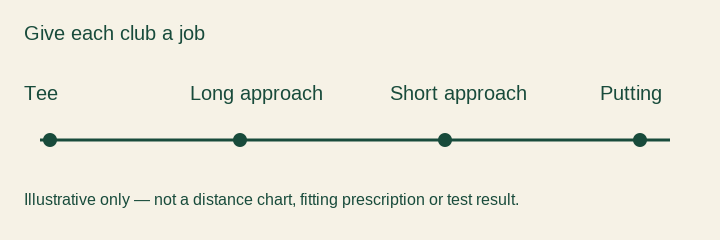
Start with fit, then give each club a job. Golf Club Field Notes helps you compare set contents, long-club choices, wedges and putter geometry without turning a product description into a promise about your score.
Hand and length first
Confirm the selected hand and playing length before judging the rest of the specification. Similar-looking listings can represent different options. If your setup requires uncomfortable reaching or crowding, use that observation as a fitting question rather than forcing your posture around a purchase.
Know what is in the bag
A package piece count may include accessories. Write down the actual clubs, verified lofts and included bag separately. Compare that inventory with the shots you need before deciding that another club closes a gap.
Make the long clubs earn their place
Use the intended task as your starting point: a tee option, a shot from turf or an approach you can practise consistently. A fairway wood, hybrid or utility iron is not automatically better because it occupies a particular category. Compare the exact selected configuration and your experience with the shot.
Plan the short end deliberately
Full-shot wedge gaps and greenside choices are related but different questions. Verify loft, bounce and grind on the selected model. Treat a putter’s blade or mallet shape, sightline, hosel and grip as features to examine, not automatic stroke prescriptions.
Keep evidence limits visible
Owner impressions can reveal feel preferences and drawbacks worth checking. They are not controlled accuracy tests, defect rates or evidence of years of reliability. Where a selected specification or warranty remains unresolved, verify it before purchase; we do not fill missing details from a related model.
A practical next step
Make a one-page inventory: exact club, selected hand and length, verified loft, usual shot and unresolved question. Bring it to a fitting or practice session. Change the decision that has a clear purpose before adding another club merely to complete a numbered sequence.
Make shaft options explicit
Record the exact shaft label for the option you try. Do not infer the right flex from age, gender or another golfer’s experience; labels are starting points, not universal fitting prescriptions. Check length, shaft and handedness before comparing head designs.
Turn loft gaps into useful questions
Compare verified lofts alongside your own observed carry ranges and the shots you use each club for. A neat numerical sequence does not predict yardages, and two differently named clubs may overlap in practice. Plan loft gaps and set composition with a worksheet that leaves unknown specifications blank.
Bring a checklist to fitting or play
Confirm hand and length; record the shaft and included clubs; compare verified lofts with your observed shot tasks; note uncomfortable setup or unresolved specifications for a fitter. For an event, check its applicable equipment requirements rather than assuming a product description establishes eligibility. Understand wedge and putter choices before treating head shape or sole labels as a fit guarantee.
Compare club choices
- Blade Putters for Simple Alignment
Compare visible design and attributed owner impressions, not universal stroke matching. Exact selected configuration and all current offers remain unverified. No hands-on testing or measured performance is claimed.
- Compact Iron Sets for Developing Players
A blade-style appearance does not establish a measured compact head. These listings do not provide a verified head-size comparison. Start with documented construction and configuration, then check fit; neither a product name nor a finish proves forgiveness or accuracy.
- Complete Golf Club Sets for New Players
A starter set is useful when it gives you a clear inventory and a sensible fit to check—not simply the biggest number on the box.
- Drivers for Recreational Golfers
A driver's model name is only the start of a useful comparison.
- Fairway Woods for Tee and Turf
A fairway wood's number is not enough information to compare it with another club.
- Game-Improvement Iron Sets
Start an iron-set comparison with the clubs actually included, then check hand, shaft, flex and playing length.
- Hybrids for Long-Club Gaps
A hybrid is a club to compare with the clubs already in your bag, not an automatic replacement for an iron with the same number.
- Mallet Putters for Alignment Preferences
Compare the shape you can see with the feel you need to try. These three exact listings offer different visual starting points; none establishes a universally correct stroke match or a guaranteed improvement. All retail offers and selected configurations remain on hold.
- Package Golf Club Sets for Women
A women's package label does not settle the fit question.
- Sand Wedges for Greenside Choices
Choose a sand wedge around the shots you need and the configuration you can actually confirm.
- Utility Irons for Tee and Long Approaches
A utility iron is not a guaranteed replacement for a driver or fairway wood. Compare the documented loft, shaft and hand configuration with the gap you want to fill; distance anecdotes cannot predict your carry or dispersion.
- Wedges for Full-Shot Gapping
A wedge fills a useful gap only when its actual loft and your carry distances fit the clubs around it. Start with your pitching wedge, identify the next distance you need, and confirm hand, shaft, loft and bounce before ordering. None of these listings establishes how far you will hit the club.